Getting into freight factoring is an exciting move. You are stepping into a space that keeps the transportation industry moving — advancing cash to carriers so they can stay on the road while waiting for brokers and shippers to pay. But before you fund your first invoice, before you sign your first client, before you even finalize your factoring agreement template, there is a foundational decision that will either protect your operation or quietly undermine it: choosing the right banking partner.
This is not a decision most new factors spend enough time on. They focus, understandably, on building their client base, setting their advance rates, and getting their back-office operations in order. But the bank you choose can determine whether your deposits clear smoothly or get flagged and rejected. In 2026, this is not a theoretical risk. It is happening to factors across the country, and it is catching people completely off guard.
Why Freight Factoring Is Uniquely Complicated for Banks
Most businesses deposit checks made out to their own name. That is what banks are built for. Freight factoring does not work that way.
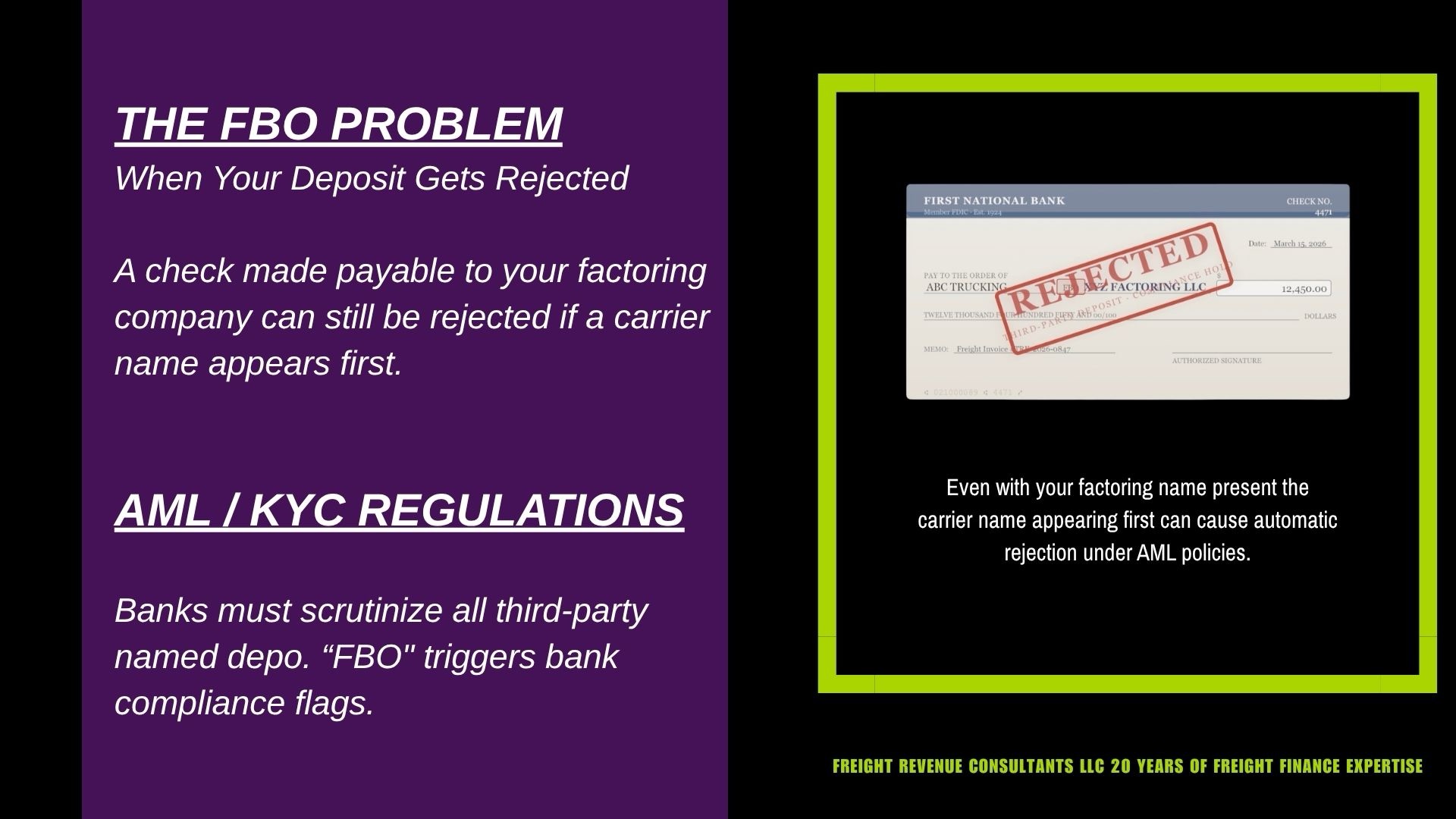
When a factor purchases a carrier’s receivable, payment comes from the broker or shipper and it often arrives with the carrier’s name on the remittance, alongside the factor’s. You might receive a check made out to “ABC TRUCKING FBO XYZ FACTORING” meaning it is made payable to the carrier, for the benefit of the factor. To a compliance officer at a bank that has never worked with freight factors, that check raises immediate questions. Whose money is this? Why is a third party named? Is this a layered transaction designed to obscure the source of funds?
“FBO” means For Benefit Of. A check reading ‘ABC TRUCKING FBO XYZ FACTORING’ may be rejected outright even though XYZ FACTORING is the legitimate creditor: simply because ABC TRUCKING appears first on the instrument.
In prior years, many banks accepted these deposits without much scrutiny. That window has largely closed.
The 2026 Regulatory Environment Is Not Forgiving
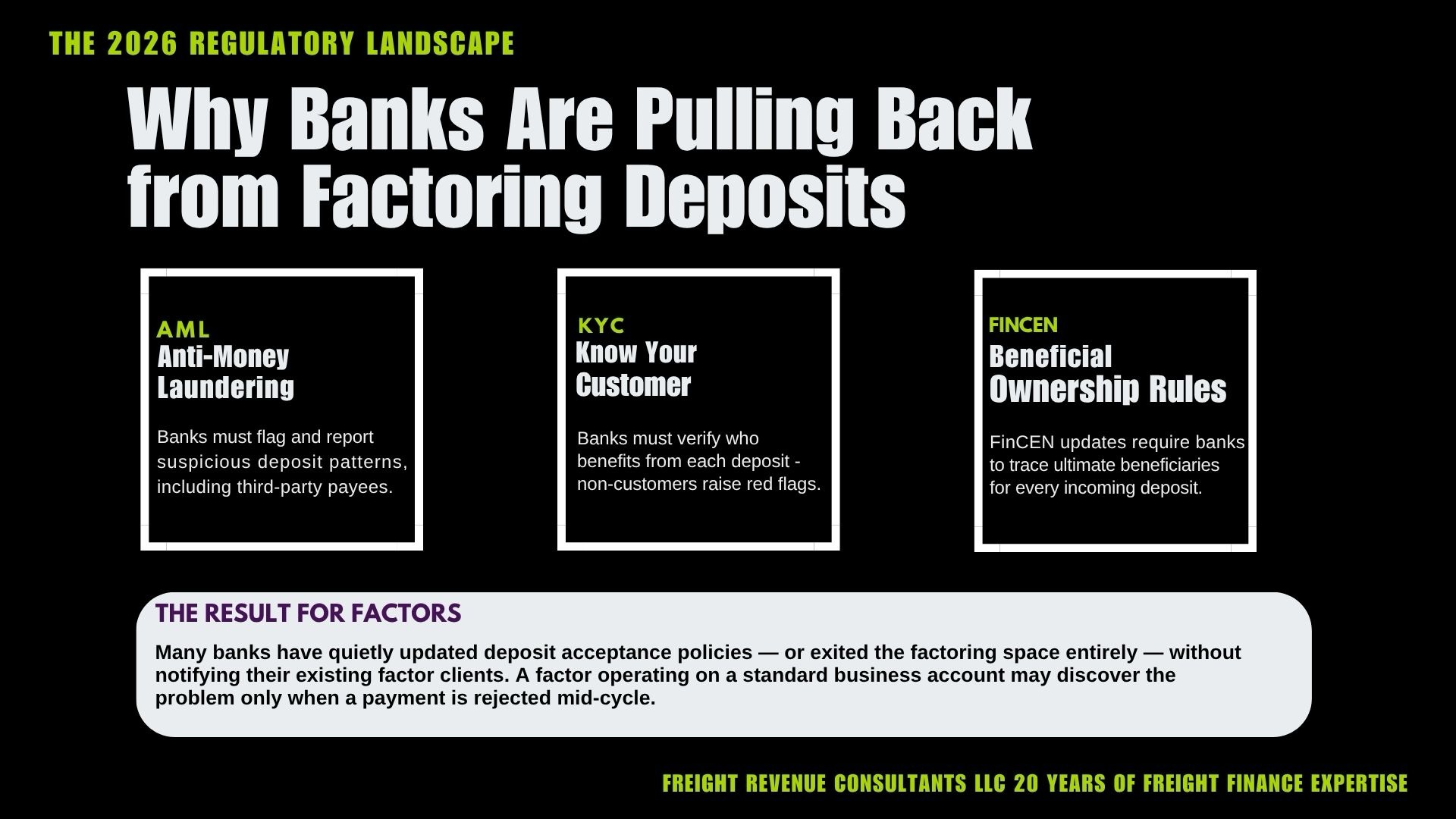
Anti-Money Laundering (AML) regulations and Know Your Customer (KYC) requirements have been tightened significantly over the past several years. FinCEN rule updates and expanded beneficial ownership disclosure requirements have put banks in a difficult position: they must verify not just who their account holder is, but who benefits from every transaction flowing through that account.
Third-party named deposits; the bread and butter of freight factoring, are precisely the kind of transaction that triggers enhanced scrutiny under these frameworks. Many banks have quietly updated their deposit acceptance policies to restrict or outright prohibit them. Some larger institutions have exited the commercial factoring deposit business entirely, calculating that the compliance burden outweighs the value of the relationship.
The result is that a factor can build a solid book of business, sign the right clients, and still find themselves in crisis because their bank stops accepting their deposits with little warning and less explanation.
What to Do When Your Bank Changes the Rules
It happens. You have been depositing without issue for months, and then one day a check is returned or held. Here is how to respond:
• Do not panic but do move quickly. A single rejected deposit can delay a carrier’s payment and damage the trust you have worked to build.
• Request the bank’s written policy on third-party deposits and FBO instruments. You need to understand exactly what changed and why.
• Escalate to your relationship manager immediately. If your bank has one, use that relationship. If they cannot resolve it, you need to know that now, not six months from now.
• Document everything. Rejection notices, correspondence, dates, and names all matter if you need to dispute a decision or demonstrate due diligence.
• Begin evaluating alternative banking relationships in parallel. Do not wait for the situation to become a crisis before you explore your options.
The core lesson here is that banking diversification is not optional for a serious factoring operation. You should never be one policy change away from an operational shutdown.
Transportation-Aware Alternatives Bridging the Gap
The good news is that the transportation finance industry has recognized this problem, and purpose-built alternatives are emerging to address it. Rather than trying to force a traditional bank to understand freight factoring, consider institutions and platforms that were built for this space:
Tank Pay (Tank Payments)
A financial infrastructure platform purpose-built for the freight industry, Tank Pay connects factors and carriers on the same financial rails. Because it was designed from the ground up for transportation payments, it understands the factor-to-carrier payment relationship in a way traditional banks simply do not.
TACH USA
A fintech platform built specifically for independent carriers and transportation businesses, with FDIC-insured business banking through partner banks. TACH was built with the cash flow realities of trucking in mind making it a natural fit for factors operating in that ecosystem.
TriumphPay / TBK Bank
Perhaps the most institutionally complete option on this list; TriumphPay, is a full transportation payments network backed by TBK Bank, SSB, an actual FDIC-insured bank. Their infrastructure connects factors, brokers, shippers, and carriers in a unified payments ecosystem, which means the compliance questions around third-party deposits are built into the architecture rather than being an afterthought.
Important caveat: Tank Pay and TACH USA are fintech platforms, not chartered banks. Your funds are FDIC-insured through their sponsor banks — but those sponsor banks can and do update their compliance postures. Always verify deposit acceptance policies in writing before committing, regardless of the platform.
Vetting a Banking Partner Before You Commit
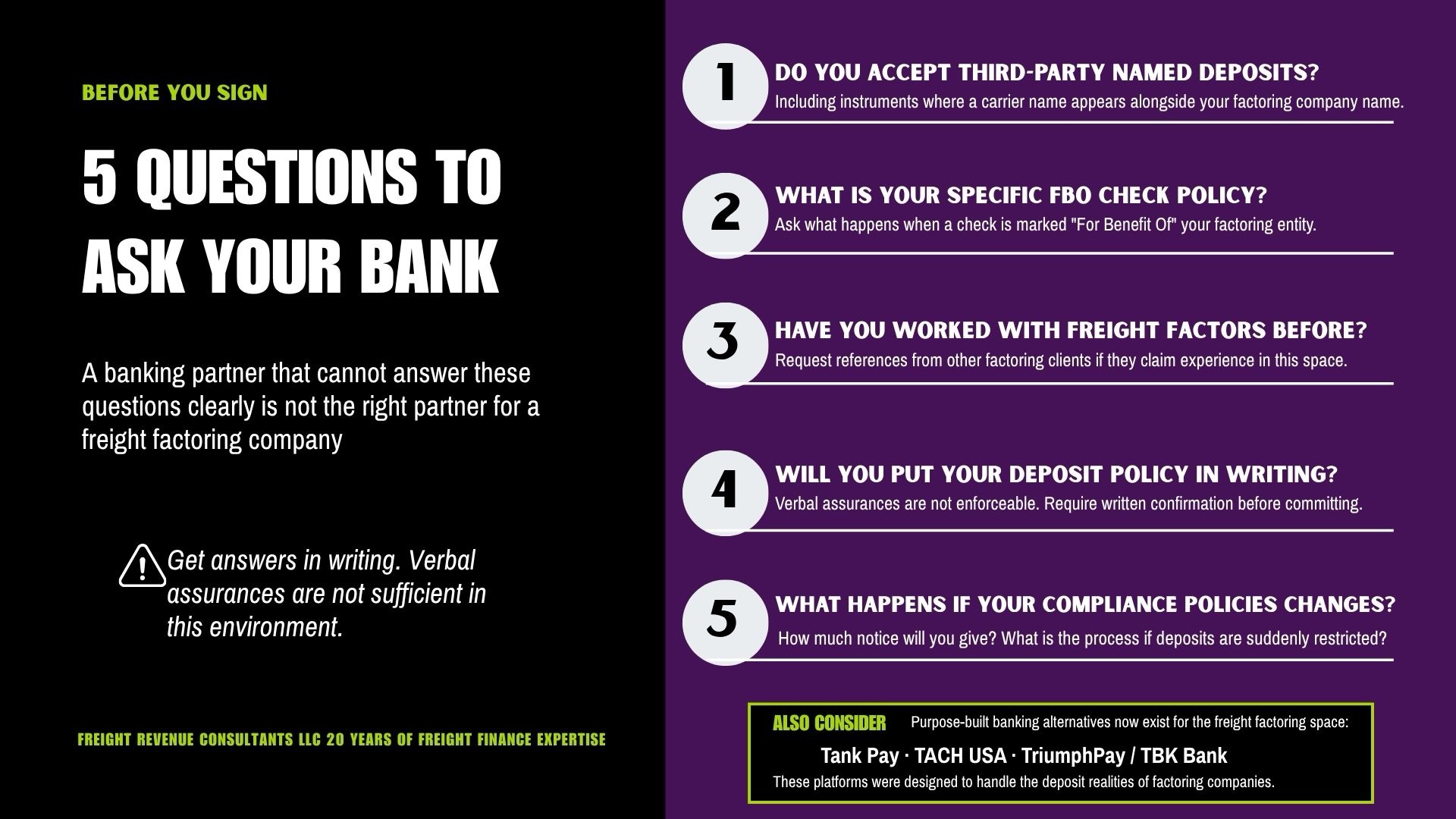
Whether you are choosing your first banking relationship or evaluating a replacement, the questions you ask before signing matter more than the rates or fees. Ask directly:
• Do you accept third-party named deposits, including FBO instruments?
• What is your specific policy on checks where a carrier name appears alongside our factoring company name?
• Have you worked with freight factoring companies before? Can you provide a reference?
• Will you put your deposit acceptance policy in writing as part of our agreement?
• What is your process if your compliance policies change and affect our deposits?
A bank that cannot answer these questions confidently, or that hedges without committing to anything in writing, is a bank that may leave you exposed. Move on.
Build to Last, Not Just to Launch
The transportation market is volatile by nature. Rates shift. Carrier counts fluctuate. Broker payment terms change. The infrastructure you build your factoring business on needs to be able to absorb those changes alongside you, and that includes your banking relationships.
At Freight Revenue Consultants LLC, we have spent 20 years helping factors navigate exactly these kinds of foundational decisions. We have seen what happens when a new factor chooses the wrong banking partner and how much ground you lose trying to recover. We have also seen what a well-structured banking relationship looks like; one that scales with your portfolio, understands your deposit patterns, and does not collapse the first time a compliance officer asks a question about a trucking check.
Getting this right at the start is not glamorous work. It will not drive your first funded invoice or close your first client. But it will determine whether the business you are building actually survives long enough to grow.
If you are launching a factoring operation and want to build on a foundation that holds, reach out to Freight Revenue Consultants LLC. The first conversation costs nothing. The mistakes it prevents might cost everything.