Every factor learns the same lesson eventually: the invoice was never the risk. The debtor was.
Small and newer factoring companies treat credit monitoring like a “someday” problem. You’re funding fast, chasing volume, and trying to keep brokers and clients happy. Building a full credit department isn’t realistic when it’s you (and maybe one other person). So the credit check happens once at onboarding—then no one looks again until something breaks.
Small and newer factoring companies treat credit monitoring like a “someday” problem. You’re funding fast, chasing volume, and trying to keep brokers and clients happy. Building a full credit department isn’t realistic when it’s you (and maybe one other person). So the credit check happens once at onboarding—then no one looks again until something breaks.
I’ve seen the pattern more than once. A debtor goes silent a couple weeks after you fund, and by the time it’s obvious, you’ve already advanced on three more invoices. A broker rushes a new client through, and it turns out to be a shell company that never had freight to move. These outcomes usually aren’t “bad luck.” They’re the predictable result of not watching what happens after day one.
Credit monitoring isn’t a large-factor luxury. For a small shop, it can be the difference between a profitable year and a handful of losses that put you underwater.

Your internal credit file is the first line of defense
A one-time bureau pull tells you what a debtor looked like on the day you checked. It doesn’t tell you what they look like six weeks later—and for smaller debtors, six weeks is plenty of time for things to change.
What actually protects you is a living internal credit file for every debtor you fund against. At minimum, track:
- Payment history and the trend (not just whether they eventually pay)
- Aging patterns (are invoices creeping from 30 → 45 → 60?)
- Dispute frequency, even when disputes are small or “resolved”
- Any history of NSF, slow pay, partial payment, or short pays
You don’t need a department to do this well. A shared report dashboard or a FMS—updated every time an invoice goes late or a dispute pops up—will catch most warning signs before they become real losses. The discipline matters more than the tool.
Where technology closes the gap
Once you’re funding more than a handful of debtors, spreadsheets stop scaling. This is where modern factoring management systems and credit tools earn their keep.
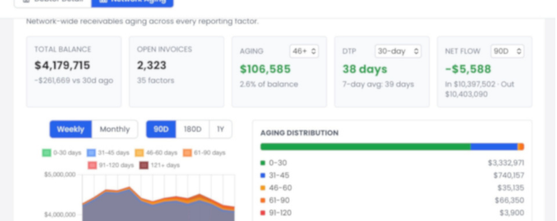
A platform like FactorCloud helps on the operational side: automated aging reports, concentration alerts when one debtor starts taking up too much of your book, and workflows that flag risk before you fund instead of after you’ve already sent money out the door. Catching a red flag pre-funding costs you nothing. Catching it post-funding costs you an invoice.
On the verification and fraud side, a tool like FactorGenie speeds up the part that used to eat hours: confirming a debtor is legitimate, checking for fraud patterns, and surfacing red flags that a manual search would miss—or that you simply don’t have time to find. For a lean team, that’s not a nice-to-have. It’s the difference between actually verifying every new debtor and skipping steps when you’re under pressure.
Neither tool replaces judgment. They give a small team the coverage that used to require a much bigger one.
Common pitfalls (before you learn them the hard way)
These patterns show up again and again with newer factors:
Funding on stale data. If your last credit check is months old, you’re underwriting who the debtor used to be.
Concentration creep. One debtor sends more volume, it feels like a win, and six months later they’re 40% of your book. If they stop paying, so do you.
Ignoring slow creep. A debtor going from 30 to 35 to 40 days isn’t a fluke. It’s usually the first sign of cash stress.
Skipping verification under pressure. When someone is pushing for a fast close, that’s exactly when a shell company or fraudulent setup is most likely to slip through. Speed and verification can coexist—but only if the process doesn’t rely on manual effort alone.
Treating disputes as noise. One dispute might be nothing. A pattern of disputes is a debtor telling you something before they say it outright.

A practical starting point
Before funding a new debtor:
- Pull current credit data (not whatever you have from months ago)
- Verify the business is legitimate and actively operating
- Check for dispute or slow-pay history with other factors, if you have access
On existing debtors, monthly:
- Review aging trends for anything moving the wrong direction
- Check concentration percentages across your book
- Revisit any debtor with even one dispute in the last quarter
None of this requires a big team or a big budget. It requires consistency—and enough structure that consistency survives growth.

This piece grew out of a conversation I didn’t get to have in person. I was set to join a panel on this exact topic and had to step back at the last minute, but the questions it would have answered are too important to leave unaddressed.
If you’re building out your credit process, FactorCloud and FactorGenie are worth a look, and I’m glad to talk through what’s worked (and what hasn’t) for shops my size.
Please follow my blog or on LinkedIn as I will be doing ongoing credit & risk coverage.