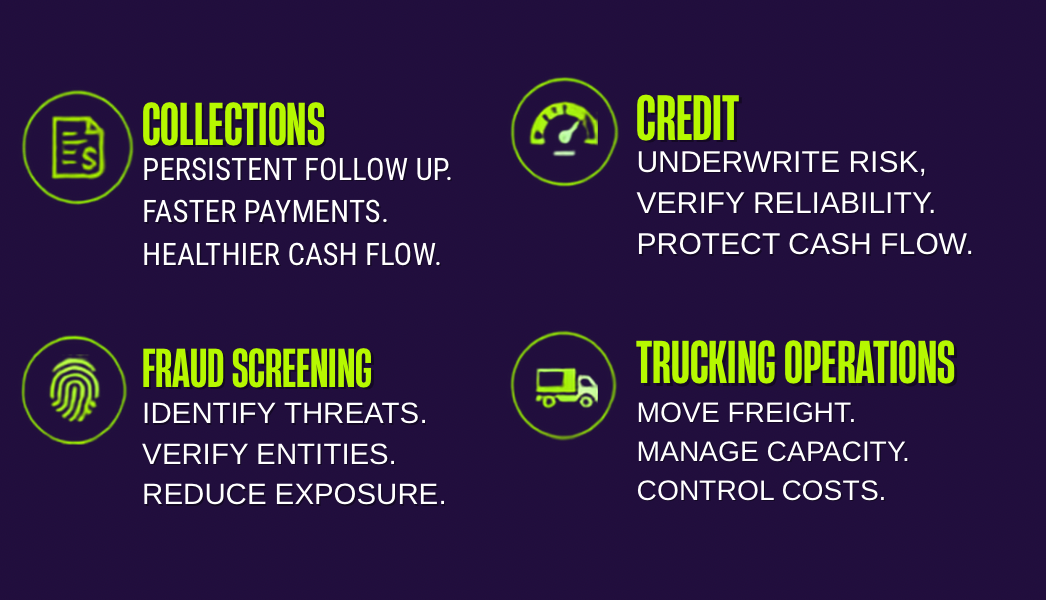
Most people who start a factoring company learn the business the expensive way. They understand finance, they raise some capital, and then they discover that credit, collections, fraud screening, and trucking operations are four separate skill sets they were expected to have on day one.
Here is the short version of the sequence we use when we help a new factor stand up a company from zero.
You are buying receivables, not lending money
A freight factoring company buys a carrier's unpaid invoices at a discount, advances most of the face value right away, and collects from the broker or shipper who owes the money. You are purchasing the receivable and stepping into the carrier's right to be paid.
That distinction drives everything after it: how you capitalize, how you secure your position, how you underwrite, and who you bank with. Get the structure right and daily operations stay manageable. Skip it and you are repairing the foundation while you fund invoices.
Step 1: Capitalize the book
Factoring is a working capital business. Every time you advance against an invoice you front your own cash and wait 30 to 60 days or longer to be repaid. Advances in trucking typically run 70% to 95% of invoice value, and your capital pool has to cover every outstanding advance at once plus a reserve for disputes and slow pays.
That number sizes your business. Know how large a book your capital can carry before you sign a client, and know how you plan to grow it. Equity first, then a bank facility or warehouse line once you have 12 to 24 months of clean operating history. We covered which banks actually lend to factors, and why applying too early works against you, in Finding Your Financial Foundation.
Step 2: Form the entity and perfect your position
Most factors operate as an LLC or corporation. The step new operators underestimate is perfecting the claim to the receivables they buy.
File a UCC-1 financing statement to publicly record your interest and establish priority over later claimants. Then send a Notice of Assignment so the broker or shipper knows the invoices have been assigned and payment comes directly to you. Without an enforceable NOA, a debtor can pay the carrier instead of you and you are left chasing your own client.
These are the mechanics of getting paid, and they sit on real law. We advise on the operational side. UCC perfection, lien priority, and the enforceability of your factoring agreement belong with a qualified factoring attorney. Build that relationship early instead of improvising it later. We can point you to one.
Step 3: Build underwriting before you fund
You underwrite the debtor, meaning the broker or shipper who ultimately pays, at least as hard as you underwrite the carrier who is your client. A carrier with perfect paperwork is worth nothing if the broker on that load does not pay.
At minimum, your policy needs to cover:
- Authority verification. Confirm operating authority and insurance before onboarding, and build the process around the USDOT number so it survives current FMCSA changes.
- Debtor credit assessment. Broker payment history decides whether an invoice is fundable and at what advance rate.
- Fraud screening. Double brokering, altered documents, and fake carrier setups are constant. Software flags patterns, but an experienced operator still catches what software misses.
- Concentration limits. Decide up front how much of your book any single debtor can represent. A limit does not guarantee you avoid losses. Funding without one is how portfolios quietly become fragile.
Step 4: Choose recourse or non-recourse
Under recourse, the carrier buys back invoices the debtor does not pay. Lower risk to you, so fees usually land around 1% to 5% per invoice cycle. Under non-recourse, you absorb losses on defined events like debtor insolvency, and fees run higher, often 3% to 7%.
Read the definitions closely. Disputes, short pays, missing paperwork, and fraud almost always stay with the carrier even under a non-recourse agreement. Neither model is better. What matters is that your advance rate, fee schedule, and reserve policy are consistent with the risk you are actually taking.

Step 5: Bank with an institution that understands factoring
This is where new factors get blindsided. Factoring deposits often arrive as third party or FBO checks naming the carrier alongside your company, and under tightened AML and KYC rules many banks now flag or reject them. We broke this down in Banking on the Wrong Partner.
Get the bank's policy on third party and FBO deposits in writing before you commit, and build redundancy so you are never one policy change away from an operational shutdown.
Step 6: Stand up operations and staffing
A factoring company runs on repeatable workflow: onboarding, invoice verification, funding, collections, and aging management. Pick your factoring and TMS software early and negotiate hard, because standard pricing rarely fits the actual shape of a portfolio. Staff for credit, collections, and operations. Collections cadence and verification discipline are what protect the book once volume climbs.
That is the terrain of our 90-Day Operational Audit and, for owners still acting as their own operator, our fractional COO work.
The part the checklists skip
Every guide online makes this look like a sequence of forms. The forms are the easy part. The hard part is judgment. Which broker looks fine on paper but pays in 75 days? Which clean load is a double brokering setup? Why has your collections cadence slipped from tight to sloppy without anyone noticing?
Our founder built a freight factoring company from the ground up over 25 years, managing large invoice portfolios, leading credit and underwriting, and designing collections infrastructure at scale. The operators we have helped launch came in understanding finance but not the operational realities of transportation. That gap is what sinks new factors, and closing it is what we do.
Thinking about starting or scaling a factoring company? Call 800-648-5450 for a free consultation. We will walk through where you are, what you are missing, and what it will take to fund your first invoice with confidence.